Work is now being done in collaboration with partners in our rural communities.
If you want to learn more or are interested in bringing equitable CS Education, AI Literacy & Digital Skills, Girls Who Code camps or clubs, and more STEM opportunities to your students, don't hesitate to contact Angela at angela@educatemaine.org.
Angela Oechslie, Director, STEM Pathways & Innovation at Educate Maine, is Maine's TechSpark Alumni Fellow. She also leads the Project>Login & Maine Mobile BioLab programs. And serves on the ECEP Executive Board.
The Microsoft TechSpark program is designed to accelerate economic growth across communities in the U.S., Mexico and Puerto Rico. Angela is focusing on computer science education expansion efforts to rural Maine and providing a community-first, community-driven model of engagement.
Check out the following resources for educators and businesses interested in growing and building digital skills.
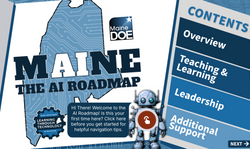
The Maine Department of Education’s (DOE) Office of Teaching and Learning is excited to announce the release of an AI Guidance Toolkit. This dynamic resource goes beyond traditional policies, this roadmap pairs guidance with learning by offering practical tools, real-world scenarios, and ongoing learning opportunities that support ethical, responsible, and effective AI use. Grounded in digital citizenship and computer science foundations, this toolkit is designed to enhance the understanding and application of artificial intelligence in education.
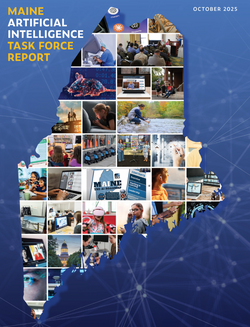
Maine's Artificial Intelligence Task Force Report and its recommendations were presented to the legislature and people of Maine in October 2025.
A comprehensive toolkit for education leaders, this resource provides strategies, tools, and guidelines for implementing AI effectively within educational settings. It includes practical steps for planning, deploying, and evaluating AI initiatives.

This roadmap offers a strategic guide for integrating AI in schools, outlining phased approaches to AI adoption. It helps educational leaders understand AI’s benefits, challenges, and pathways for creating an AI-ready school culture.
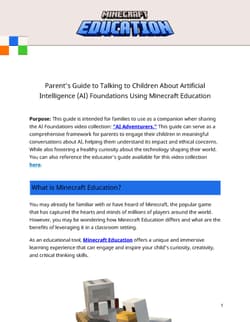
This guide empowers parents to introduce children to AI concepts in an accessible way, using Minecraft Education as a fun, interactive platform for learning. It provides tips and activities to help children understand AI’s impact and uses in everyday life.
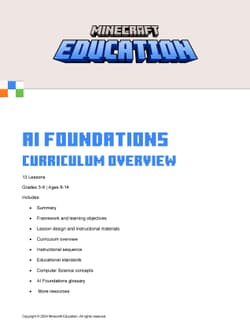
This foundational course introduces key AI concepts and applications, preparing learners for the rapidly evolving AI landscape. It covers ethical considerations, practical skills, and essential AI knowledge suited for students and educators alike.
AI4SP's Digital Skills Compass™, based on input from 25,000+ individuals, offers free benchmarking and gap analysis reports.
Code.org’s AI resources offer free, hands-on activities and lesson plans for students to explore AI technology. These resources aim to build foundational AI skills in K-12 students and highlight the technology’s relevance across different subjects.

Northeastern’s Institute for Experiential AI emphasizes real-world AI applications, supporting research, learning, and innovation in the field. It offers programs for students, educators, and professionals interested in AI’s role in problem-solving and experiential learning.
This series of webinars from UMaine's New Media department delivers quick, engaging sessions on emerging technologies, including AI. The webinars aim to enhance digital literacy, offering insights and tips on AI applications for various fields.
TechSpark’s AI Learning Sprint Series provides hands-on learning sessions focused on AI basics, applications, and ethics, designed for educators and students. These interactive sessions help participants understand and apply AI concepts in practical ways.
Northstar offers online training in essential digital skills, focusing on areas like basic computer use, internet safety, and productivity tools. This training supports learners in developing digital literacy skills critical for today’s job market.

The National Digital Equity Center provides training and resources to bridge digital divides, offering courses and support on internet skills, digital tools, and more to foster equitable access to technology.

This initiative offers curated courses through LinkedIn Learning, Microsoft, and GitHub, focusing on high-demand digital and technical skills. It’s designed to help learners develop the competencies needed for today’s tech-driven jobs.
Through a grant from the Maine Department of Economic and Community Development (DECD), the Maine Immigrants' Rights Coalition (MIRC) has partnered with Boston-based Resilient Coders, IntWork, The Delmar Group, and Blueprint Maine to launch our pilot to launch our pilot project: “Pathways to Software Engineering”. This collaborative effort will train historically marginalized racially, ethnically, and linguistically diverse youth across Southern Maine for careers as software engineers. This fall, a cohort of diverse youth will learn to code, for free, with a stipend.

Upright Education offers immersive tech bootcamps covering fields like web development, data science, and software engineering. These programs equip participants with job-ready skills for careers in tech through intensive, hands-on learning experiences.